Showing posts with label research.. Show all posts

Thursday, April 7, 2011

Review: The Immortal Life of Henrietta Lacks

This book had honestly been on my to-read list forever. My mom read it over the summer, and as soon as she started talking about the subjects it addresses-- medicine, cell biology, history, bioethics-- I knew it would be right up my alley.


The book itself is a work of non-fiction chronicling the life of Henrietta Lacks, a young African-American women who died of cervical cancer in the early 1950s. Just before her death, her physician scraped a few cells from her tumor, and, without her knowledge or consent, began growing them in culture.  Today, descendants of those cells, nicknamed "HeLa",  are used in nearly every cell culture lab on the planet.

Observe:

snapped a couple of days ago in my lab. 
although I don't personally work with HeLa cells, lots
of folks at the EPFL do. 

To be honest,  the book left me with somewhat mixed feelings.  I really enjoyed the portions talking about Henrietta's life and the lives of her family members. The author did a fantastic job explaining how Henrietta's descendants battled with the ethical implications of HeLa cells, and it definitely got me thinking about bioethics in general. What I didn't like, however, was how the book treated the actual science. I'll be honest-- I'm up to my ears in cell culture and definitely biased, but I thought the science portions were overly simplified.

The verdict? 3/5

Monday, April 4, 2011

2011 Whitaker Conference: Beautiful Budapest

Ben and I just returned from the 2011 Whitaker Grantee Enrichment Seminar in Budapest, Hungary!

beautiful budapest. 
The conference itself was designed for all Fellows and Scholars receiving funding through the Whitaker foundation, and it was absolutely fantastic. We spent four days in the heart of Budapest, presenting our own research and listening to the research of others. It was a great opportunity to learn about some of the hot topics in biomedical engineering, as well as to receive feedback on our own work.

the view from my hotel room.  
One of my favorite aspects of the conference was our discussion on the different cultural approaches to biomedical engineering research. Since Whitaker Fellows and Scholars are sprinkled across the globe, we were able to discuss how research in Cape Town compares to research in Paris, and how the Italian approach differs from that in Taiwan. It was certainly an enlightening week, and a great chance to learn more about biomedical engineering, both from a technical and cultural point of view. 

Although I honestly loved our time spent in the conference room, I also really enjoyed the time spent we exploring Budapest. Budapest is enormous, sprawling, and absolutely soaked in history. Although I could have easily stayed there much, much longer, we did manage to squeeze a lot into the short time we had.

Some of my favorites: 

the chain bridge.
the chain bridge was built in 1849 to unite the communities
of Buda and Pest. in many ways, the construction of the
chain bridge is what allowed budapest to develop
into the metropolis it is today. 
lions on the bridge! according to local legend, after
finishing the design of the bridge, the architect suddenly
realized he forgot to give the lions tongues, and promptly
threw himself overboard. 
parliament. 
budapest synagogue. after the new york city synagogue,
this is the largest in the world. 
back of the holocaust. 
holocaust memorial tree. each of the willow's leaves is transcribed in multiple
names. 
monument to carl lutz,who issued fake passports and documents--
ultimately saving tens of thousands of budapest jews during
world war 2. 
the terror museum, and a unique look into budapest's more recent history.
the museum documents two of the darker points in budapest history: occupation
by nazi germany and soviet occupation. 
this photo is less trivial than it looks:
it's the first mcdonald's in a communist country!
although this art deco market was bustling 50 years ago,
the construction of a major city highway has left it
pretty deserted. 
loved the ceiling!
as always, I love stopping to listen to street performers.
this guy's water-glass skills were particularly impressive!

On our last evening in Budapest, we had the opportunity to experience a super-special treat: a dinner and wine tasting cruise along the Danube river. It was a wonderful evening of lively conversation, fantastic food and wine, and beautiful views of Budapest by night.

parliament by night. 
the chain bridge twinkling. 
ben + me + budapest! too bad it's blurry.... 
the swiss whitakers! 

Tuesday, March 15, 2011

Up, up, and away!

Dear National Geographic,

If for some reason the whole medical school/research thing doesn't work out, please hire me. In addition to really enjoying your magazine, writing, and photography, I'm pretty much obsessed with your latest Pixar-inspired project, and I would gladly help you float houses with balloons any day.

Love,

Vanessa

poster from disney pixar's up
national geographic's version. 

If you haven't seen National Geographic's latest project, check it out! It's a real-life version of Up, one of my favorite Pixar films. Pretty amazing, if you ask me.

the balloons are enormous!
I love that they used so many different colors- definitely adds to the project,
don't you think?
and we have lift off! also: please note that
there is an actual person inside the flying
house. 
love this. seriously. so cool. 
up, up, and away!

Monday, February 21, 2011

Ben blogs, too!

Despite my insistence that it's a pretty awesome hobby, no, Ben didn't start his own blog.

He did, however, write this post for Kaggle, a platform for data mining and prediction competitions.

I'll be the first to admit I know very little about data mining. While I'm sure it's an exciting field with a lot of potential, I'll stick to my cells and cytokines, thank you very much. However, despite being pretty unfamiliar with the field, I still thought that Ben's blog post was well-written, interesting, and actually not that hard to follow. You should read it!

Thursday, January 13, 2011

One Hundred and Fifteen Pages of Science

Yesterday, I filled up my first lab note book for the LLCB! Although I knew I had completed a lot of experiments, I was still surprised- I have actually written one hundred and fifteen pages of research: experimental set-ups, observations, data tables, pasted in graphs and images.

my very-full first lab notebook. 
on to number two! 

While I know I have accomplished a lot in my research, I still feel like I should have something more concrete to show for all my work, some sort of definite conclusion. Instead, what I am actually able to conclude is closer to, "I suspect that assays A, B, and C can show that cytokines D, E, F, and G will cause cells H and I to exhibit behaviors J and K. However, to be more certain, I still need to run experiments LMNOPQRSTUVXYZ......"

Oh Science, why must you move so slowly?

Thursday, October 21, 2010

A Matter of Scale

In addition to climbing mountains and pretending to know how to cook, I spend a lot of my time in Switzerland doing research, where I work with with very, very small cells, proteins, antibodies, as well as other microscopic biomolecules. Sometimes it’s hard to grasp just how small these guys really are.

lovely cells. very small. 
I read a lot of science blogs/articles/etc (ginormous nerd, I know). and came across this.

I thought it was pretty well done-it starts with a coffee bean and zooms in to a carbon atom, and traces the size and scale of several biological entities in between. In addition to being fun, it also helps you to get a feel for the size of this tiny world I spend a ridiculous amount of time trying to understand.

Thursday, October 14, 2010

Lecture from a Legend

A couple of days ago, I attended a lecture given by James D. Watson.

That’s right--- the Watson, as in, the Watson-and-Crick Watson; the discovering-the-structure-of-DNA Watson. The same Watson featured in just about every entry-level biology text book in the world. Needless to say, I was ridiculously excited.

watson & crick won the nobel prize in 1962 for determing the
structure of dna.
source.
The lecture was different than I thought it would be. Rather than speak about the importance of structure in determining function, or ramifications of his work, Watson gave a biography of his own life. He talked about his childhood, his high school experiences, his exposure to science in college, and the string of circumstances leading up to his pivotal work with DNA.  

Throughout his story, two facts became apparent to me:

       1. Watson is incredibly, incredibly focused.
       2. Watson is opinionated to a fault.

james d. watson, 1954
source
Focus:

One of the things I admired most about Watson was his incredible focus. He talked about how, as an undergrad, he heard about DNA and became absolutely fascinated. At the time, nearly all biologists assumed that proteins (which are considerably more complicated that DNA) functioned as genetic material, and that DNA was just “junk” that also happened to be in the cell’s nucleus.  For the next several years, Watson chased the study of DNA, moving from a PhD at Indiana University to a post-doc position in Coppenhagen, constantly frustrated that no one else seemed to find DNA nearly as compelling as he did.  Watson’s obsession with the structure of DNA eventually led him to Cambridge, England. While the group he joined wasn’t working on the structure of DNA, they were determining the structure of other macromolecules, and for Watson, that was as close as he was going to get.


He began collaborating with Francis Crick largely because, in Watson’s words, “He was the only person that would bother to listen to me.” Watson also added that, “Francis was definitely brighter than me, but he was a physicist and I was a biologist. Despite being less intelligent, I was far more motivated.”  This really surprised me. In my mind, I had always imagined Watson and Crick as some sort of “dream team,” but the more Watson spoke, the more it became apparent that he was really their driving force. As more and more scientists became involved in the race to solve the puzzle of DNA, it was Watson’s unstoppable focus that ultimately allowed his name to be associated with the infamous structure. When asked why he believed he was the first to unlock the structure, he simply said, "The reason I won is simply because, for many, many, many years, I couldn’t think about anything else.”

watson & crick, as depicted by the 1987 bbc film
the race for the double helix.
source
Opinions:

Just as Watson was very frank in admitting his obsession with DNA, he was also very frank in admitting his (rather controversial) personal opinions. He quickly let it be known that he was a devout atheist and strongly doubted the scientific aptitude of anyone who "still believed a God was necessary." Although Watson only hinted at it in his lecture, perhaps his most controversial ideas are his attitudes towards race. This article sums up his views nicely. He is also a strong advocate for genetic screening, arguing that in the future the “really stupid” bottom 10% of people could be eliminated , as well as screens to make people more physically attractive.
watson today, cold springs harbor, new york.
source.
Advice:

I left Watson’s talk a little perplexed. On the one hand, I greatly admired his incredible drive, focus, and scientific diligence. On the other, I found some of his personal opinions a bit upsetting. Regardless, when he ended his lecture with a few points of advice for all young and upcoming scientists in the crowd, I made sure to jot down his suggestions:

-- james d. watson

Finally: apologies for the science and text-heavy post! less words and more pictures tomorrow :)
Thursday, October 7, 2010

A Different Shade of Beauty


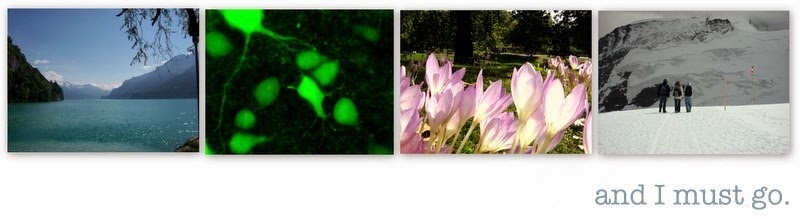
Although I wish it were true, I sadly do not spend the majority of time in Switzerland walking alongside the lakefront, snapping photos in parks, and exploring new and exciting cities. While I was a little slow diving into my research project, things have really started to fly. Without really stopping to catch my breath, I’ve moved from experiment to experiment, growing cells, analyzing data, and taking some pretty fascinating microscopy images.

While these images definitely lack the natural majesty of the lake and mountains, I still think there’s something fascinating about them. Being able to look at cells (actual, human cells!) and attempt to observe and understand how these insanely complex machines function—well, for me at least, there’s a natural beauty in that as well. 

 very cool. 

Thursday, September 23, 2010

A Smattering

Good news!
I’ve made it onto my lab’s website!

Good news, the sequel
My permit arrived in the mail, and I’m now an official Swiss Resident!

Scandinavia Bound 
One of my really great friends, Ashley, is studying at the Copenhagen Business School in Copenhagen, Denmark. Yesterday evening, Ben and I booked plane tickets to visit her! Needless to say, I’m super excited- both to spend time with Ashley, whom I haven’t seen since graduation, and visit another new city and culture.
ashley and me. spring 2009.
me and ashley by the sea of galilee, israel. winter 2010.
Christian Exchange Students Group
This evening, Ben and I both attended the first meeting of the Christian Exchange Students group, hosted by Westlake Church Lausanne. While the meeting itself was fairly small- maybe 20 or so people- the talk was by the amazing Thomas Rizzo, the EPFL’s Dean of Basic Sciences. Rizzo spoke about the mixing of Faith and Science, and, as both an accomplished scientist and a Christian, his message was informed, relevant, and inspiring.  

Although the Christian Exchange Student group only meets once a month, there will be a weekly Bible study Ben and I are both hoping to attend and several ski trips this winter that I am already excited about. It's difficult to look out at the Alps every day and not think about how much fun it would be to ski down them!

Beans and Veggies and Rice—oh my!
Although it took Ben and me a few tries to determine what constituted good spaghetti sauce in Lausanne, our mixed beans, veggies, and rice was perfected on the first try. 
mixed beans, mixed veggies, whole-grain rice and a little
gruyere cheese to sprinkle on top. delicious!
my amazing co-chef.
Ever Growing
Remember my blue-stained cells from before? Remember how my image only showed two of them? Look what happens when you add in a little growth factor….

voila! lots of cells!
It’s not a ground-breaking research discovery (it’s not really a discovery at all), but I still always enjoy watching (and imaging) all the molecules I've read so much about actually do what the textbooks say they do. 


Saturday, September 18, 2010

Microscopically Speaking

I spent the majority of yesterday in what I’ve over the years dubbed as a “Microscope Cave”.  In order to get nice, clear images, most microscopes are kept in dark rooms. This is especially true of fluorescent microscopy, the type I was doing today.

microscope caves are a little differerent...
source
It definitely wasn’t my first Microscope Cave experience. Although microscopy has never been a formal interest of mine, by chance, many of the projects I’ve worked on and jobs I’ve held in the past have involved a lot of ‘scoping:
mouse cortex, summer 2008.
staining a particular neuron with a
micropipette, summer 2008.
microscope and micropipette, summer
2009.
stratum lucidum, late fall 2009.
And now I’m back at it again!

lovely blue-stained cells,  fall 2010.
These particular cells have been stained blue by a dye called DAPI, a molecule that binds super-duper tightly to DNA. When DAPI binds to a certain region of DNA (called the major groove) it fluoresces a bright blue light that can easily be seen by a microscope. Since all cells have DNA, it’s a really easy way to distinguish cells from other random debris- just look at what’s blue vs. what’s not blue.  However, since all cells have DNA, DAPI isn’t very good at distinguishing one type of cell from another- they all just look blue.

Although science is great fun (at least, I think it is!) Ben and I did manage to go on a wonderful day-trip today- photos and travel-talk are coming soon!

French words of the day: rouge, bleu, vert, jaune, purpe, orange: red, blue, green, yellow, purple, orange. 

Monday, September 13, 2010

Can we play the name game?

First day in my new lab! Annnnnd…….it was overwhelming. Let’s be honest—aren’t most first days?

I met Amanda, the PhD student I’ll be working closely with this morning, and she showed me around the lab. Although I had already attended a lab meeting, I hadn’t really gotten a chance to tour the facilities or meet all of the lab members.

I was completely overwhelmed. The last few labs and project teams I’ve been a part of have been relatively small- the Yin and Groh labs consisted of maybe a dozen team members, and my research team at Medtronic had only handful. Most of my previous lab spaces have been fairly small as well, generally consisting of one main room with perhaps 1-2 smaller rooms for specialty techniques, such as imaging or histology.  

The Swartz lab wasn’t like that. The rooms went on and on and on- office spaces and laser rooms, cell culture centers and wet lab benches. And the people! Amanda introduced me to far, far more people than I could ever remember, people whose name I’d really like to be able to recall, but couldn’t come close if I tried. If it were up to me, I would have had the entire lab go outside, sit in a circle, and play the name game. Hi, my name is Vanessa and if I were going on a picnic….

After I met the people I don’t remember, Amanda introduced me to Vero, the lab manager. Vero walked me through the lab safety protocol. From what I can tell, it’s a pretty strict, clean lab—conditions that often lend to good quality experiments and all-around better science, but can be a bit annoying to get used to.

I ate lunch with Amanda and another post-doc, Ryan. Here, I finally shifted to actually thinking and talking about scientific theory. Amanda and Ryan helped craft together my project proposal, and together, they explained what some of their individual goals were.  After lunch, Amanda and I met with Melody, the head of the lab, to gain even more clarity on the big picture of what I will be looking at. Finally, after days of background reading and lots and lots of questions, I was starting to get a clear of idea of what I was going to do and how I was going to do it.

Well, sort of.  That’s the problem with research, isn’t it? It’s easy to create a hypothesis and even easier to come up with a research question, but to actually design an experiment, eliminate unnecessary variables, and get the whole set-up to work? That’s the tricky part. That’s also the reason my day, aside from trying to memorize about nine billion new names, has been kind of overwhelming. After Amanda and I met with Melody, I headed to the Wave, dug out my good friend Google Scholar, and started reading more and more and more papers, trying to get a better feel for how on earth I was going to set up an experiment to answer the questions my lab was trying to ask.


French words of the day: poivron, oigon, champignon, ail, sel, poivre = bell pepper, onion, mushroom, garlic, salt, pepper. (That’s what Ben and I put in our spaghetti tonight. I would have posted photos, but it turned out pretty unfortunate, and I just can’t bring myself to photograph icky-tasting food.)